Guide
Do ATS resume scanners actually work?
ATS systems store and parse applications; auto-rejection on keyword count is rare. What recruiters do instead, and a better workflow. Assess your first role free.
If you have spent an evening rewriting a résumé to beat an applicant tracking system, you are not alone. The popular story is that an ATS is a robot gatekeeper that auto-rejects your CV unless you hit a magic keyword threshold. That story is mostly wrong. ATS software stores, parses, and surfaces applications for recruiters. Rejection usually comes from human filters, rigid search rules, or sheer volume, not from a hidden scanner deducting points for every missing term.
This article explains what ATS systems actually do, what third-party "scanners" measure, and where your effort is better spent. If you are unsure whether a role is worth rewriting for, you can assess your first role free before you touch keywords. For tool comparisons, our résumé tools for career changers roundup and the comparison hub map which products optimise which part of the pipeline.
The short answer: what ATS scanners actually do
An applicant tracking system is a database and workflow tool, not a single "scanner" sitting between you and a human. When you apply, the employer's ATS typically parses your file into fields (name, employers, dates, education), stores the record, and makes it searchable for recruiters filling that requisition (the recruiter's term for the open role).
Automatic hard rejection based purely on keyword count is the exception, not the rule. Most employers use filters and rankings configured by their recruiting team: degree requirements, years of experience, title keywords, employment gaps, and knockout questions (application questions that reject automatically, such as work authorisation). A third-party keyword tool such as Jobscan or Rezi simulates term overlap between your CV and a posting. That is useful, but it is not the same system reading your application on the employer side.
How an applicant tracking system handles your resume
Think of the pipeline in six steps: you submit an application, the ATS parses the file, the record is stored against the open role, a recruiter searches or filters the pool, optional ranking or automated matching may reorder results, and a human reviews a subset.
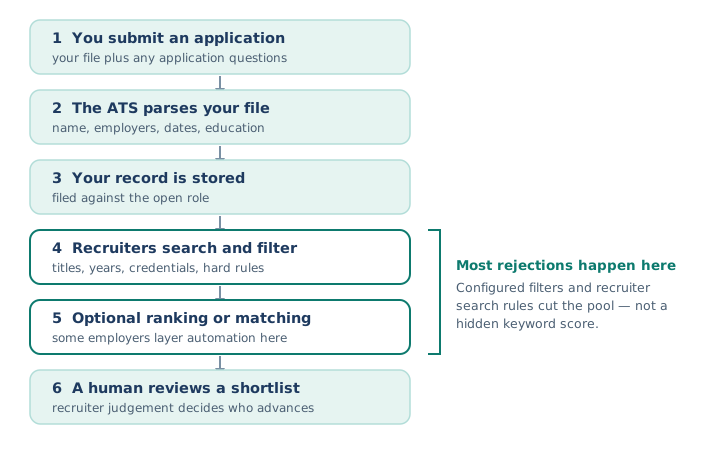
Major vendors include Workday, Greenhouse, Lever, iCIMS, and Taleo. They do not all behave identically. Some lean on structured application forms; others rely more heavily on parsed résumé text. What they share is organisational purpose: track who applied, where each candidate sits in the process, and give recruiters tools to manage volume.
That is different from a keyword-match tool you run at home. Jobscan compares your résumé text to a job description and reports a match percentage and gap list. Rezi generates ATS-oriented drafts with keyword guidance. Both are legitimate products for a specific job: refining a document you have already decided to submit. Neither tells you whether the role is worth pursuing, and neither is the employer's ATS.
What ATS parsing can and cannot read
Parsing extracts plain text from your file and maps it to fields. It works well on standard section headings, chronological job entries, and simple bullet lists. It struggles with headers and footers, dense tables, text inside graphics, multi-column layouts, and some PDF encodings. A garbled parse can mislabel your current title or drop a section entirely.
The folklore that you must use a single-column template or the ATS will "reject" you is overstated. Readable structure still matters because humans read what survives parsing. Recruiters scanning a list of candidates look for familiar patterns: name, recent title, employer, dates, education. An eye-tracking study by TheLadders (2018) found recruiters spent about six seconds on an initial fit-or-no-fit pass, with most attention on those core fields rather than long descriptive paragraphs.
Use a clean, conventional layout. Prefer .docx or a text-based PDF over a design-heavy export. Do not sacrifice clarity chasing a myth that one extra column guarantees elimination.
Do keyword match scores predict who gets interviewed?
Honestly: weakly, at best. A high match score means your résumé echoes the posting's vocabulary. That can surface missing terms once you have chosen to apply, especially when your field uses different jargon than the job description. It does not prove you can do the work, and it does not mean a recruiter will shortlist you.
Career changers see this most clearly. A low score often reflects vocabulary mismatch between industries, not a real capability gap. Chasing every keyword can bury the transferable story that actually wins the interview. The Rolevera vs Jobscan comparison lays out when gap scoring helps and when fit reasoning should come first. The Rolevera vs Rezi comparison covers the same trade-off for fast draft generation.
Keyword overlap is also a different problem from large-language-model self-preference in screening. Term-matching tools do not address evaluator bias toward a particular writing style. They can even push you toward generic, interchangeable phrasing if you treat the gap list as a stuffing checklist.
Why strong candidates still vanish from the pile
Qualified people disappear from hiring pipelines for reasons that have little to do with whether their résumé contained every keyword. Fuller, Raman, Sage-Gavin and Hines (2021) surveyed employers across the US, UK, and Germany and found that more than 90% use recruitment management systems to initially filter or rank candidates (92% for high-skills roles, 94% for middle-skills). Those systems are tuned for efficiency: narrow the pool using proxies such as degrees, precise skill labels, and years of experience.
Many systems also exclude applicants who fail yes-or-no rules, such as employment gaps, regardless of other qualifications. Reporting on the study noted that about half of US companies filter out candidates with a gap in full-time employment longer than six months.
High application volume compounds the problem. Recruiters run search queries that never surface your CV because your title string does not match their filter, not because a scanner scored you at 61% instead of 79%. That is why decision-first applying matters. Optimising keywords for a role you should skip is wasted effort. A fit assessment tells you whether the investment is plausible before you rewrite anything.
What recruiters actually do with your application
The ATS is infrastructure. Recruiters still drive who advances. The Employ Recruiter Nation Report 2024 surveyed more than 1,200 talent acquisition decision makers in North America and found average time to fill a role had dropped to 41 days, with teams leaning on technology to handle volume. Sixty-three percent already use automation to augment recruiting technology; among that group, 89% use it frequently. Candidate matching (55%) and intelligent sourcing (44%) were common use cases.
SHRM's 2024 Talent Trends research found that among organisations using automation for recruiting, about one in three use it to review or screen applicant résumés, alongside tasks like generating job descriptions and automating candidate searches. SHRM also reported that nearly half of HR professionals said the quantity of applications they must manually review had improved because of these tools, which underscores that humans are still in the loop reviewing what automation surfaces.
None of this means every employer reads every CV. It means rejection is usually a stack of configured rules, recruiter judgement, and time pressure, not a single omniscient scanner deducting points in the background. Emerging automated screening raises separate fairness questions, including model self-preference, which we covered in our research summary on résumé screening bias.
ATS myths vs what actually happens
| Myth | What actually happens |
|---|---|
| "ATS rejects 75% of résumés automatically" | No reliable primary source supports a universal rejection rate. Rejection is usually filters, volume, and recruiter search behaviour, not a fixed auto-cull percentage. |
| "You must match every keyword in the job description" | Recruiters look for relevant experience and credible titles. Keyword parity is one input; stuffing terms you cannot defend fails in interview. |
| "Tables and two columns always break parsing" | Parsing can garble complex layouts, but simple multi-column or table formats often parse adequately. Clarity for human readers matters more than template dogma. |
| "A high Jobscan score guarantees an interview" | Match tools report term overlap. They do not control employer filters, recruiter priorities, or internal shortlists. |
What each approach optimises
| Approach | What it measures | Best used when |
|---|---|---|
| Employer ATS | Storage, parsing, recruiter search and workflow | You do not control this side of the process |
| Keyword tools (Jobscan, Rezi) | Term overlap vs a pasted job description | After you have decided to apply and want a gap list |
| Fit assessment (Rolevera) | Person-to-role fit and evidence gaps | Before you rewrite anything for a specific posting |
A better workflow than chasing 100% ATS match
Work in this order.
First, decide whether the role is worth applying to. Fit assessment belongs before document work. Spending an evening tuning keywords for a pivot that is unlikely to land is the expensive failure mode, regardless of which system reads the file.
Second, tailor honestly. Translate your real experience into the language of the posting without inventing scope, inflating titles, or adding skills you have not used professionally. Substance should change because the role demands different emphasis, not because a gap report told you to paste adjectives.
Third, run a keyword pass only if you are submitting. Treat the score as a vocabulary checklist, not a gate. The comparison hub explains which tools serve which step.
Fourth, keep the format clean and every claim defensible in the room. Parsing quirks matter less than whether a recruiter, in six seconds or six minutes, can see a credible match between your history and their open role.
You can assess your first role free and see whether the opportunity is realistic before you commit to a rewrite.
FAQ
Do ATS systems automatically reject resumes?
Usually not in the way myth suggests. Most systems store and parse applications, then apply recruiter-configured filters and searches. Hard auto-rejection exists for knockout questions and rigid rules, but a universal keyword-based auto-reject is uncommon.
What is a good ATS match score?
There is no universal threshold. Treat a match score as a gap list: terms and phrases in the posting that do not appear in your CV. Useful after you have decided to apply; misleading as a verdict on whether you should apply.
Do I need an ATS-friendly template?
You need a readable, conventional layout that parses cleanly and scans well for humans. Extreme template rules (single font, no tables ever) are often overstated. Clarity beats folklore.
Are ATS scanners the same as AI resume screeners?
No. Employer ATS platforms manage applications and workflow. Third-party keyword tools simulate term overlap. Some employers also use automated résumé screening or large language models as evaluators, which is a separate layer with different risks.
Should I use Jobscan or Rezi before applying?
Use them after you have decided to submit, to spot vocabulary gaps or speed up a draft. Use a fit assessment before that decision if you are unsure the role is worth your time. Neither replaces knowing whether your background actually matches the role.